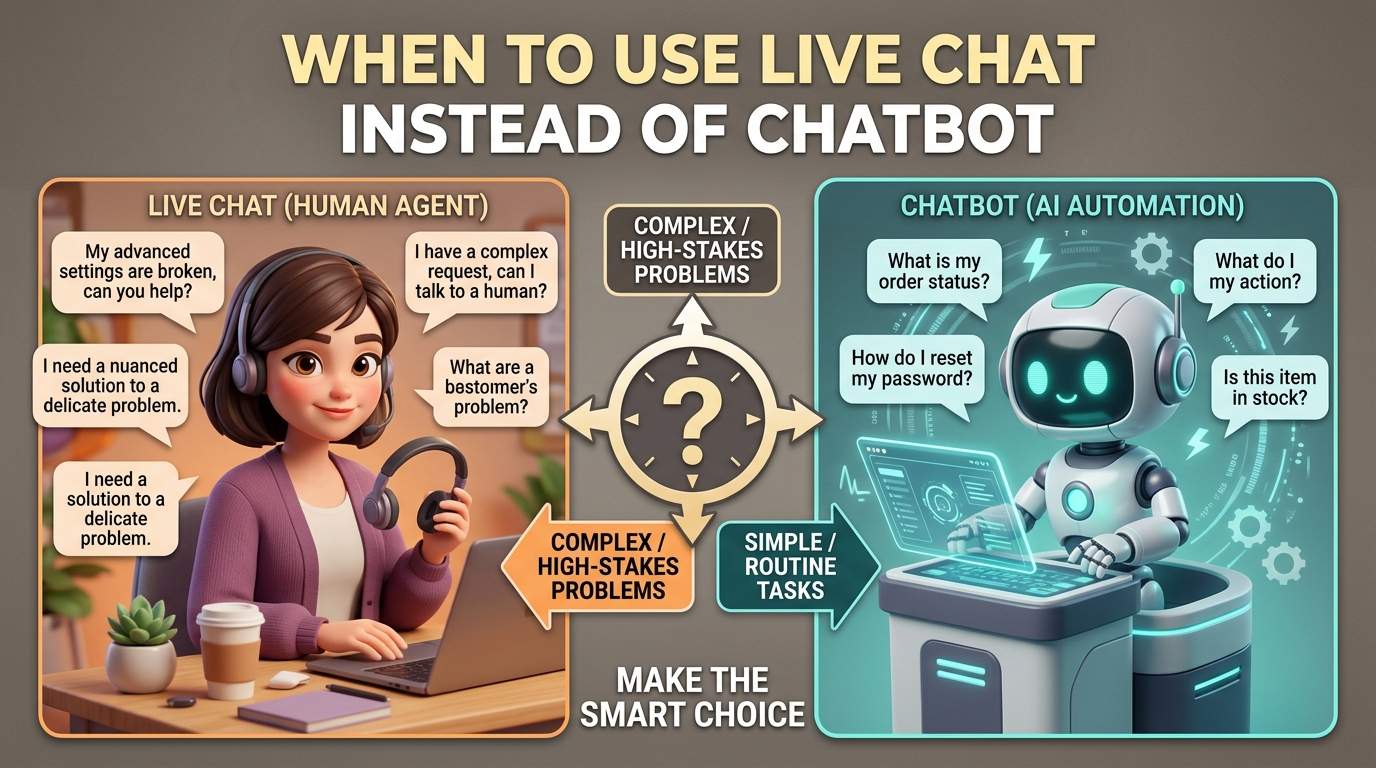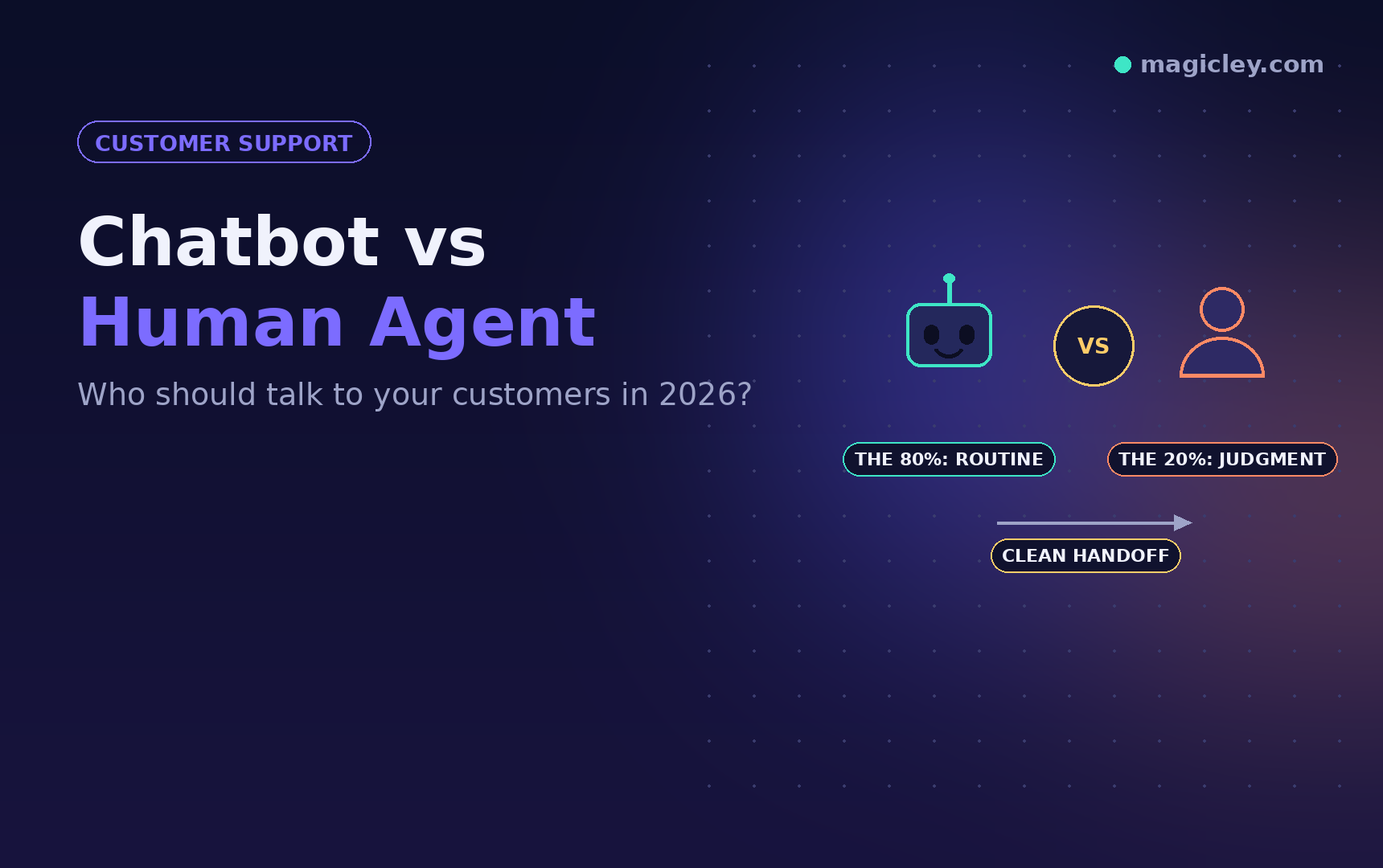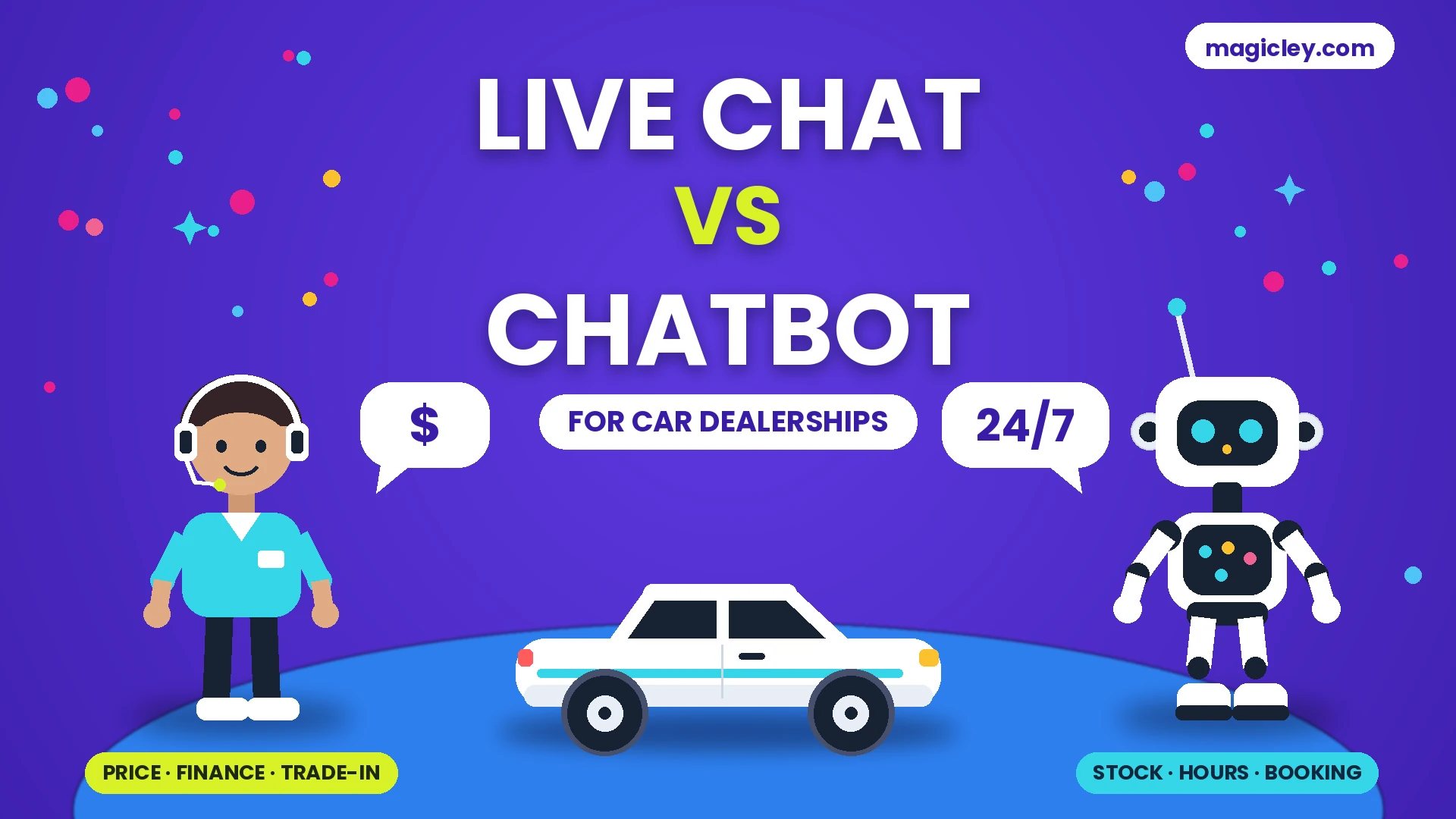
A dealership should use a chatbot to answer stock, hours and booking questions at any hour and to capture leads after closing. It should use live chat, staffed by its own team or a managed service, for trade-in values, pricing, financing and complaints. Most stores need both, with the bot passing every serious shopper to a person.
The buyer figures below come from Cox Automotive's 2025 Car Buyer Journey Study; the wage figure is from the US Bureau of Labor Statistics. Both are linked where they appear.
What is the difference between live chat and a chatbot on a dealership website?
Live chat puts a person in the chat window: one of your salespeople, a business development rep, or an agent at a company you pay to answer for you. A chatbot is software that replies on its own, either from a fixed script or, with newer AI chatbots, from your inventory pages and policies.
The shopper sees the same widget either way. What changes is who is answering, at what hours, and how far the answer can be trusted on money questions.
Which questions should each one answer?
Give the chatbot the questions with one correct, written-down answer. Give people the questions that involve a number you would have to stand behind.
|
The shopper asks |
Best answered by |
Why |
|
"Do you have this model in stock?" |
Chatbot |
The answer is on your inventory page |
|
"What time do you close? Where are you?" |
Chatbot |
Fixed facts, asked constantly |
|
"Can I book a test drive?" |
Chatbot |
Collect name, vehicle and time, then confirm |
|
"Can I book a service appointment?" |
Chatbot |
Same pattern, plus mileage and the problem |
|
"What's my trade-in worth?" |
Chatbot collects, person answers |
The bot gathers make, model, year and mileage; an appraiser gives the figure |
|
"What's your best price?" |
Person |
Negotiation needs judgment and authority |
|
"What would my monthly payment be?" |
Person |
Credit and payment quotes are regulated; see below |
|
"I have a problem with the car I bought" |
Person |
A complaint needs someone who can fix it |
|
Anything sent after closing |
Chatbot |
Captures the lead instead of losing it |
Do car buyers actually want to chat with a bot?
Some do, and most still finish the purchase in person. In Cox Automotive's 2025 Car Buyer Journey Study, which surveyed 2,300 recent buyers:
-
25% of new-vehicle buyers used AI tools while shopping.
-
59% reported high satisfaction with AI-powered assistance.
-
7% bought completely online, while 53% completed every step at the dealership.
-
63% said a mix of online and in-store would be ideal.
For a dealership, that makes chat a bridge to the visit. Its job is to answer the early questions quickly and get the shopper booked, and a chatbot can do that part. The same study found 48% of buyers want to apply for credit online but only 33% do, which is the part of the journey where a person still has to be involved.
Which is cheaper for a dealership?
A chatbot is usually cheaper per conversation, and staffed chat is usually worth more per conversation. Compare them on the same unit.
Cost per chat for a person = hourly wage ÷ chats handled per hour
The US median wage for a customer service representative is $21.53 an hour (Bureau of Labor Statistics, May 2025). At six chats an hour that is about $3.59 per chat in wages alone, before benefits, software and management. Use your own team's pay and pace in place of those numbers.
Chat for dealerships is sold three ways, so ask each vendor which one applies:
-
A flat monthly fee for chatbot software.
-
A fee per resolved conversation for some AI agents.
-
A fee per lead or per month for managed live chat, where the vendor's staff answer for you.
Then weigh the cost against what a conversation is worth. One chat that turns into a sold vehicle pays for a great many chats, so the cheapest option is not automatically the right one for sales questions. It usually is the right one for "what time do you close?"
When does live chat win at a dealership?
Live chat wins whenever the answer is a number or a promise. That covers price, payment, trade-in value, availability holds and anything a customer is upset about.
It also wins when your store sells on relationship. If your pitch is that shoppers deal with a real person from the first message, a bot in the widget contradicts it. We list more cases in seven situations where live chat beats a chatbot.
When does a chatbot win at a dealership?
A chatbot wins on coverage and on repeated questions. Shoppers browse inventory in the evening and at weekends, and a bot can answer and take their details when nobody is at a desk.
It also frees your team. Every stock, hours and directions question a bot answers is one your salespeople are not typing out again. The general case is covered in our chatbot vs live chat comparison.
What should a dealership chatbot never do on its own?
Four things should always go to a person:
-
Quote a payment, a rate or an out-the-door price. Advertising credit terms is regulated, and a wrong figure in writing is a problem you own. Ask whoever handles compliance for your store before a bot states any number.
-
Value a trade-in. It can collect the details; it should not name a price.
-
Promise a vehicle is available or held. Stock changes during the day.
-
Handle a complaint or a warranty dispute. Route these straight to a manager.
More on drawing that line is in when a human agent should take over.
How should the handoff to a salesperson work?
The bot should pass the lead with everything the shopper has already said, so the salesperson starts where the bot stopped.
-
Collect the basics: name, phone or email, the vehicle they asked about, and any trade-in details.
-
Ask when they want to be contacted and by what method.
-
Send it to your CRM, not only to an inbox, with the full transcript attached.
-
Tell the shopper what happens next and when.
-
Offer a person at any point. "Talk to someone" should always be visible.
Before you choose any tool, ask whether it connects to the CRM or dealer management system you already use. A lead that sits in a separate inbox is easy to lose.
How do you know it is working?
Track four numbers each month:
|
Metric |
What it tells you |
|
Leads captured outside opening hours |
Whether the bot is covering the gap |
|
Appointments booked, and how many showed up |
Whether chats turn into visits |
|
Time to first reply during opening hours |
Whether your staffed chat is keeping up |
|
Share of bot chats handed to a person |
Whether the bot is answering or just delaying |
FAQ: Live Chat vs Chatbot for Dealerships
Is live chat or a chatbot better for a car dealership?
Neither alone. A chatbot is better for stock, hours and booking questions and for after-hours leads. Live chat is better for price, financing, trade-ins and complaints.
Is AI chat the same as live chat?
No. AI chat is software that writes its own replies. Live chat has a person answering, whether that is your own staff or a managed chat service.
Can a chatbot quote monthly payments?
It should not do so on its own. Have it collect the shopper's budget and hand off to a person who can give a compliant quote.
Will a chatbot replace my BDC or sales team?
No. It takes the repeated early questions and the after-hours messages. Your team still handles negotiation, finance and delivery.
What should I ask a chat vendor before buying?
How it is priced, whether it connects to your CRM or DMS, how handoff to a person works, and who is responsible for what the bot says.
Magicley, is a general chatbot builder and not a dealership-specific system. If you want to test whether a bot trained on your own inventory and policy pages can handle your early questions, you can build one with custom templates and compare it with your current chat.