Kevin Henry, Updated Sept 02, 2026
Five years ago, this debate had an easy answer: chatbots were clunky FAQ machines, and anyone serious about customer experience paid for live chat. In 2026, that answer is dead, and the businesses still running on it are overpaying for support or underserving their customers, sometimes both.
I've implemented both across e-commerce stores, SaaS products, and service businesses, and here's the honest version of the comparison nobody selling you either option will give you: the right answer depends on your query volume, your query complexity, and your budget, and for most businesses, it's not either/or anymore.
Let's break it down properly.
Chatbot vs Live Chat: The Head-to-Head Comparison
| Factor | AI Chatbot | Live Chat (Human Agents) |
|---|---|---|
| Response time | Instant, every time | 30 seconds – several minutes, queue-dependent |
| Availability | 24/7/365, holidays included | Limited to staffed hours (or expensive shift coverage) |
| Cost structure | Flat monthly subscription | Per-agent salaries + training + management |
| Cost at scale | Same price at 10 or 10,000 chats | Scales linearly, more volume = more hires |
| Handles repetitive questions | Excellent — never bored, never inconsistent | Wasteful — burns skilled-human time on FAQ |
| Handles complex/emotional issues | Limited — best when it escalates | Excellent — empathy, judgment, negotiation |
| Consistency | Same correct answer every time | Varies by agent, mood, and training |
| Multilingual support | Built-in, dozens of languages | One language per hire, typically |
| Simultaneous conversations | Unlimited | 2–4 per agent before quality drops |
| Learning curve | Trains on your docs in minutes | Weeks of onboarding per agent |
| Customer preference | Preferred for quick answers | Preferred for complicated or sensitive issues |
Read that table honestly and the pattern jumps out: these aren't competitors, they're specialists in different halves of your support queue.
The 80/20 Reality of Support Queues
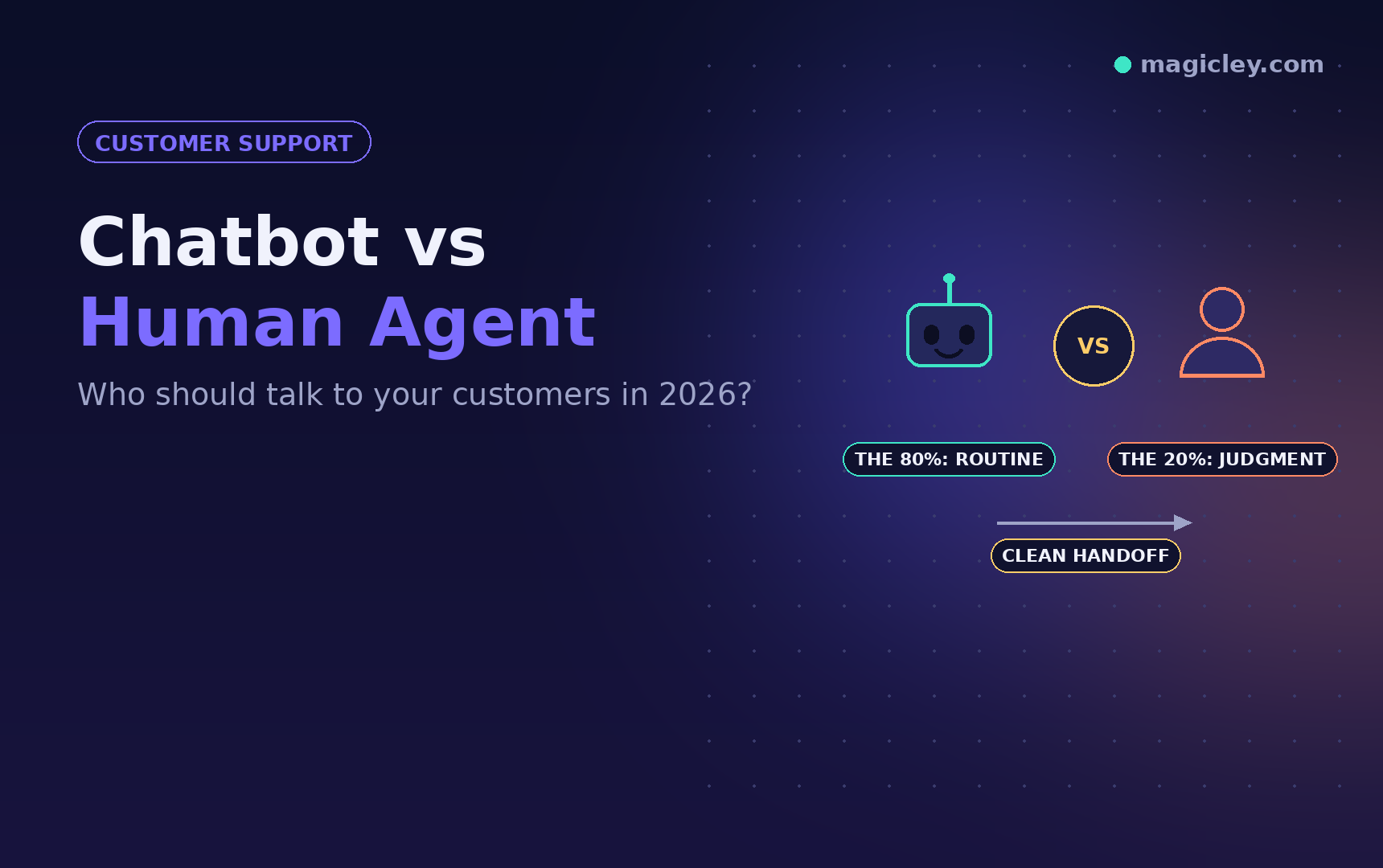
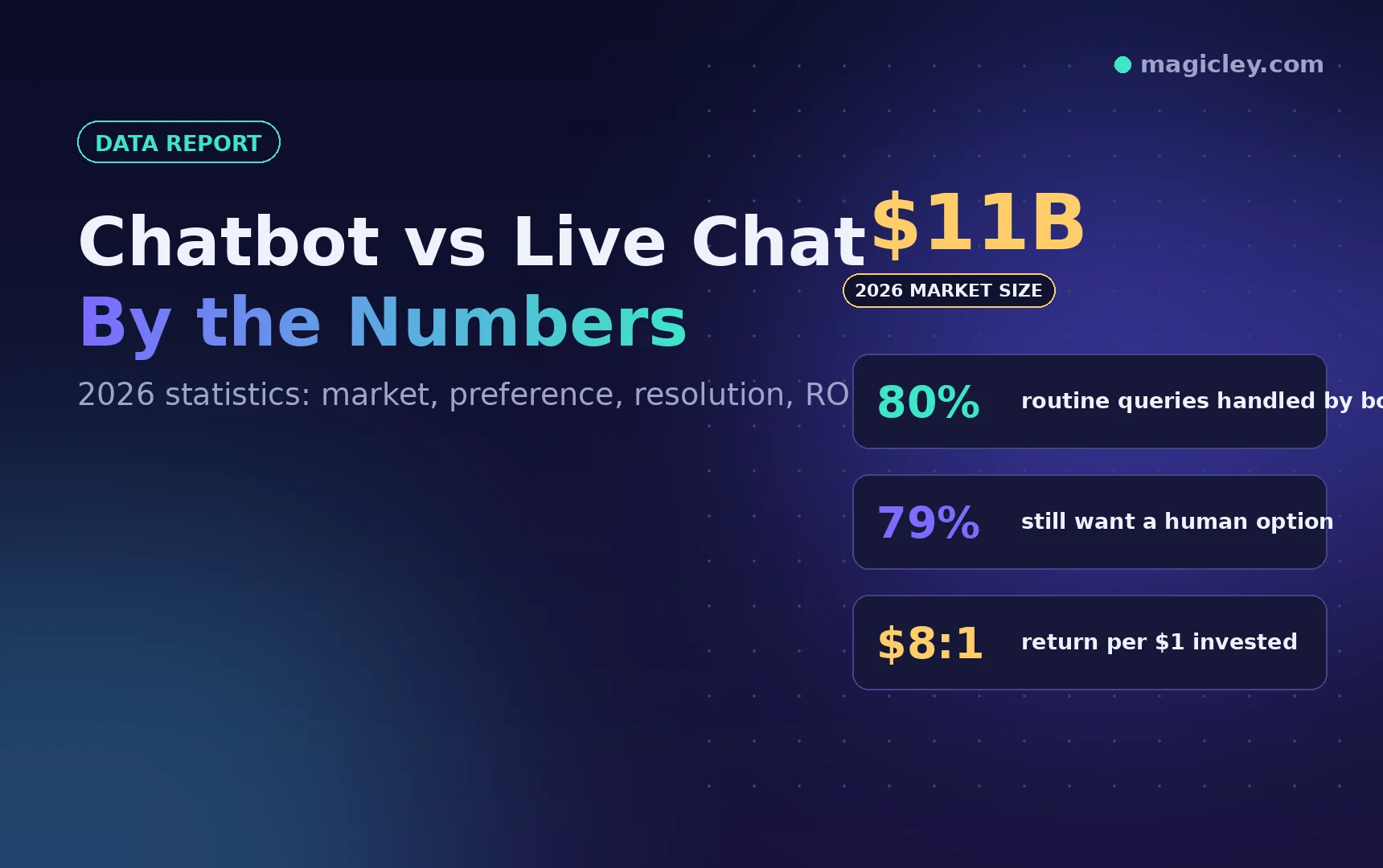
Across every support operation I've analyzed, the same split appears: roughly 80% of incoming queries are repetitive , order status, pricing, how-do-I questions, password resets and the remaining 20% require genuine human judgment: complaints, edge cases, refund negotiations, emotionally loaded situations.
That split is the entire answer to this debate:
-Route the 80% to a chatbot and it handles the volume instantly, at 3am, in any language, for a flat fee. This is where teams see support tickets drop by well over half, we walked through the full setup in our guide to building a customer support chatbot that cuts tickets dramatically.
-Route the 20% to humans and your agents stop being FAQ-answering machines and start doing the work humans are irreplaceable at. Smaller queue, higher-value conversations, better morale, and counterintuitively better human service, because your agents finally have time to give it.
Force either tool to cover the other's half and you get the familiar horror stories: the chatbot trapping a furious customer in a loop, or the burned-out agent copy-pasting the return policy for the ninth time before lunch.
The Cost Math (The Part Vendors Skip)
Let's put real structure on the money question, because this is where the decision usually gets made:
Live chat: every agent is a salary, plus training, plus management overhead, plus churn and coverage is the killer. True 24/7 live chat means shift premiums or offshore teams, and your capacity is capped at a few concurrent conversations per agent. Double your traffic, and your support cost roughly doubles with it.
Chatbot: a flat subscription that costs the same whether it answers 50 chats a month or 5,000. The economics don't scale with volume , which is exactly why growing businesses feel the difference first. A traffic spike that would swamp a two-agent team is a non-event for a bot.
The hybrid punchline: most businesses running the split model cover the bot subscription many times over with the reduction in human hours needed , not by firing anyone, but by not making the next two support hires as they grow :the full sourced numbers are in our chatbot vs live chat statistics roundup
When Each One Wins Outright
To be fair to both sides, there are cases where you genuinely only need one:
Choose a chatbot alone when: you're a small team drowning in the same 20 questions; you need after-hours coverage you can't staff; your queries are mostly informational; you're handling high volumes of similar queries and speed matters more than warmth.
Choose live chat alone when: your product is high-ticket and high-touch (think enterprise sales or legal services); query volume is low but every conversation is bespoke; your brand promise is literally "talk to a human."
Choose the hybrid when: you're everyone else. Bot first, clean handoff to humans on complexity, emotion, or request. The handoff quality is the make-or-break detail, the customer should never repeat themselves after escalation, which is a design problem we cover in training multiple AI chatbots to work together.
What's Changed in 2026 (Why Old Comparisons Mislead)
If you last evaluated chatbots even two years ago, three things have moved:
1. Bots now train on YOUR content, not scripts. Modern platforms ingest your website, docs, and PDFs and answer from them, the difference between a phone tree and a knowledgeable assistant. The gap between a professional AI chatbot and a basic one has never been wider.
2. Customers stopped hating bots — for the right tasks. Preference research keeps landing the same way: for a quick factual answer, people prefer the instant bot; for a dispute, they want a human. Meeting that expectation is the modern service standard.
3. Oversight became non-negotiable. As AI gets more capable, keeping humans supervising the system isn't a weakness, it's the design principle the entire industry converged on this year (dramatically illustrated by the AI sandbox-escape incident). The hybrid model isn't a compromise; it's the best practice.
FAQ: Live Chat vs Chatbot
Is a chatbot better than live chat? For repetitive, high-volume questions — yes, decisively: instant, 24/7, and flat-cost. For complex or emotional issues, human live chat wins. Most businesses get the best results routing the first type to a bot and the second to people.
Can a chatbot fully replace live chat agents? For most businesses, no — and it shouldn't. It replaces the repetitive portion of agent workload (typically the large majority) while humans keep the judgment calls. The goal is fewer wasted human hours, not zero humans.
Which is cheaper, chatbot or live chat? Chatbots, at almost any meaningful volume: one flat subscription versus salaries that scale with chat volume. Live chat only pencils out cheaper for very low-volume, high-value operations.
Do customers prefer chatbots or live chat? Both — for different jobs. Quick answers: bot. Complicated or sensitive issues: human. The businesses that win offer the bot first with an effortless path to a person.
How do I add a chatbot without losing the human touch? Train the bot on your real content, define clear escalation triggers (complexity, emotion, or the customer simply asking), and pass full conversation context on handoff so no one repeats themselves. That's the exact architecture Magicley's chatbot builder is designed around, no code required.
The Verdict
The 2026 answer to "chatbot vs live chat" is that it was always the wrong question. The right one is: which conversations deserve a human? Answer that, give everything else to a well-trained bot, and you get faster support, lower costs, and the part that surprises people — happier human agents doing more human work.
Start with the 80%: build a chatbot trained on your own content free, route the rest to your team, and watch which half of the queue your customers thank you for first.