Kevin Henry, July 26, 2026
A few months ago, I watched a business torpedo its own customer experience with AI. They had three chatbots, one for sales, one for support, one for FAQs. Each bot was actually pretty good on its own. The problem? The sales bot promised a feature the support bot said didn't exist, and the FAQ bot quoted a price from two updates ago.
Three smart bots. Zero synchronization. The customer left confused, and probably didn't come back.
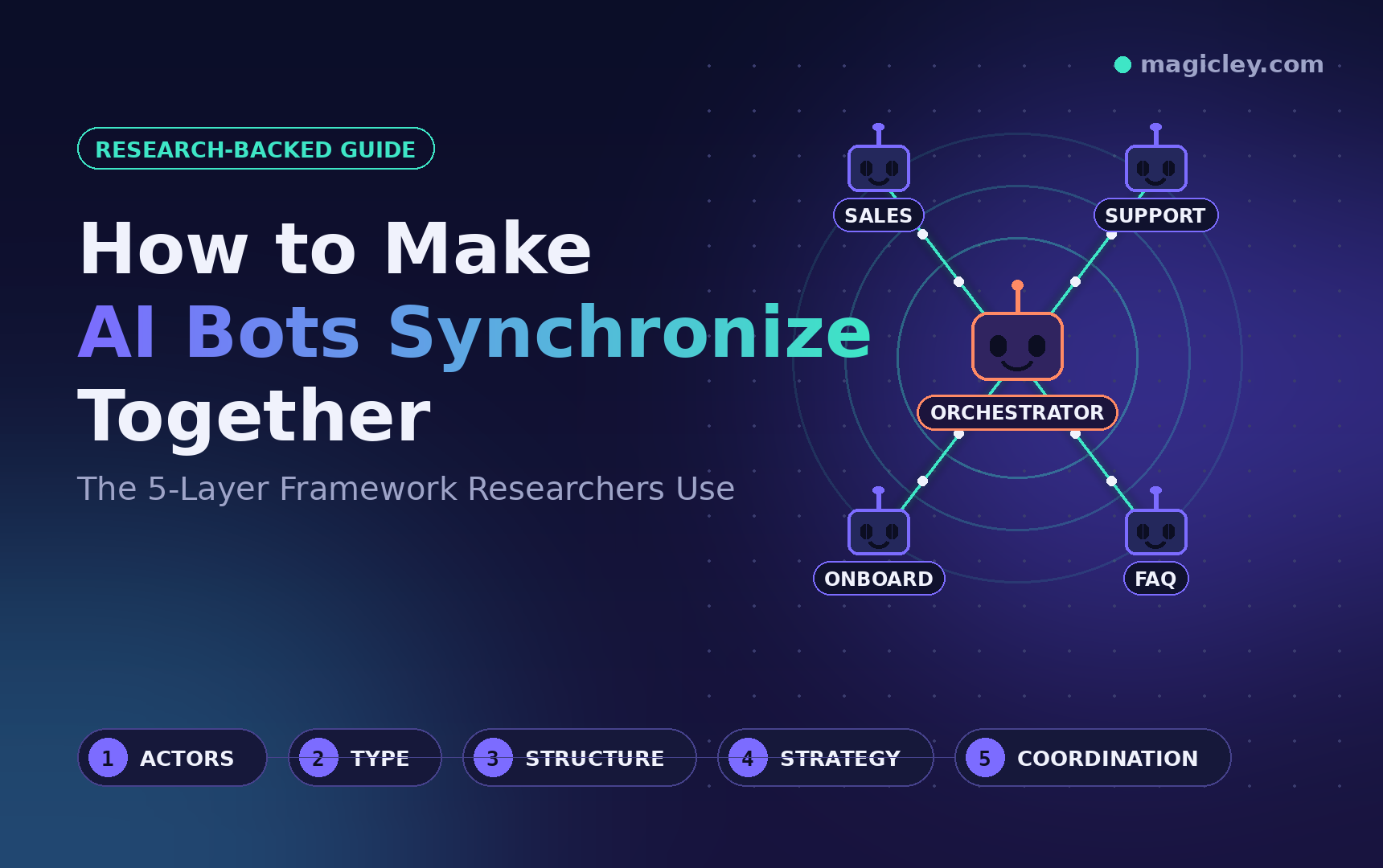
If you're running (or planning) more than one AI bot, this is the problem you need to solve before anything else. And here's the good news: you don't have to guess your way through it. Researchers have been studying exactly how AI agents coordinate, and a comprehensive 2025 survey of multi-agent collaboration mechanisms (Tran et al., arXiv:2501.06322) gives us a clear framework, five layers that determine whether your bots work as a team or a mob.
Let me walk you through each layer in plain English, with the practical steps to apply it to your own business.
Why Synchronization Is the Whole Game
First, a reality check. A research team analyzed more than 1,600 execution traces from seven popular multi-agent frameworks to figure out why these systems break down (Cemri et al., arXiv:2503.13657). Their taxonomy identified 14 distinct failure modes, and they cluster into just three buckets:
- System design issues — the bots were set up with unclear roles or fuzzy task boundaries
- Inter-agent misalignment — the bots didn't share information or contradicted each other
- Task verification gaps — nobody (and no bot) checked the final answer
Notice something? None of these are "the AI wasn't smart enough." They're all coordination problems. The intelligence of each individual bot matters far less than how well the team is wired together. That's what the 5-layer framework fixes.
Layer 1: Actors — Decide Who's on the Team
Before your bots can synchronize, each one needs a crystal-clear identity. The research calls this defining your "actors" which agents exist and what each is responsible for.
In practice, that means writing a one-line job description per bot:
- Support bot: answers troubleshooting and account questions from the help docs
- Sales bot: handles pricing, plans, and product questions
- Onboarding bot: guides new users through setup
The mistake I see constantly is overlap — two bots that both "kind of" handle billing questions. Overlapping roles are where contradictions breed. If you've already built one strong specialist by following our guide to building a customer support chatbot, you've done Layer 1 for your first actor. Now repeat that clarity for every bot you add.
Layer 2: Type — Choose How They Relate
Here's where the research gets surprisingly interesting. The survey identifies three relationship types between agents: cooperation, competition, and a hybrid the authors call "coopetition."
For most businesses, cooperation is the default, bots share a goal and pass work to each other. But don't dismiss the other two:
- Competition has real uses: run two draft bots against each other and let a judge pick the better answer. Research on multi-agent debate (Du et al., ICML 2023) found that having models challenge each other's reasoning can improve factual accuracy.
- Coopetition is the practical middle ground: a "verifier bot" whose entire job is to double-check what the other bots say before it reaches a customer. Remember failure bucket #3 above — verification gaps? This is the fix.
For a small business, my advice is simple: start with pure cooperation, and add one verifier bot once you have three or more agents in play.
Layer 3: Structure — Pick Your Network Shape
This is the layer most people skip, and it's the one that determines how synchronization actually flows. The research describes three structures:
- Centralized: one orchestrator bot receives every request and routes it to the right specialist. Think air traffic control.
- Peer-to-peer: bots hand off directly to each other with no middleman. Think a jazz band trading solos.
- Distributed: no fixed hierarchy at all, flexible, but much harder to debug.
For business use, centralized wins almost every time. When one router bot controls the flow, you always know why a customer ended up talking to a particular bot, and there's a single place to fix routing mistakes. We covered the orchestration mindset in our guide on training multiple AI chatbots to work together , the conductor-and-orchestra model described there is a centralized structure in action.
Peer-to-peer starts to make sense only when your bots live on different platforms and need to talk across systems , which is exactly the problem new interoperability protocols like Google's A2A are being built to solve (Ehtesham et al., arXiv:2505.02279).
Layer 4: Strategy — Role-Based Beats Improvised
The fourth dimension is how agents decide who does what. The survey contrasts role-based strategies (each agent has a fixed specialty and a defined lane) with model-based strategies (agents dynamically size up each situation and negotiate who acts).
Dynamic negotiation sounds futuristic, but for customer-facing bots it's a liability — it produces unpredictable behavior, and unpredictability is what erodes customer trust. Role-based assignment is boring, and boring is exactly what you want: the pricing question always goes to the sales bot, the error message always goes to support.
This is also where bot quality compounds. A role-based system is only as good as its specialists, which is why pro AI chatbots with specialized expertise outperform a general-purpose bot wearing five hats.
Layer 5: Coordination — The Synchronization Layer Itself
Everything above sets the stage; this layer is where synchronization literally happens. Two mechanisms matter most:
1. Shared knowledge. Your bots must draw answers from the same source of truth. In research systems this shows up as shared memory architectures where every agent reads from a common workspace. In practice, it means training all your bots on the same, current knowledge base, same docs, same pricing, same policies. Update it once, and every bot updates together. This single habit eliminates the contradiction problem from my opening story.
2. Handoff rules. Define exactly when a bot passes a conversation to another bot, or to a human. Modern agent protocols formalize this with explicit task states (submitted, working, input required, completed), and you should mirror that discipline even in a simple setup: every handoff should carry the conversation context with it, so the customer never repeats themselves. And when the issue needs empathy or judgment, route to a person , we broke down where humans still beat bots in our chatbot vs live chat comparison.
Putting It All Together with Magicley
Here's the 5-layer framework as a build order you can execute this week using Magicley's AI chatbot builder:
- Actors: Create one bot per job -support, sales, onboarding, each with a one-line mission.
- Type: Set them to cooperate; plan a verifier bot for later.
- Structure: Make your main website bot the centralized router that hands off to specialists.
- Strategy: Lock each bot into its lane with role-specific instructions.
- Coordination: Train every bot from the same knowledge base (your website content or PDFs work), and write your handoff rules including the human-handoff trigger.
No code required for any of it, and because every bot pulls from one knowledge source, synchronization is built in rather than bolted on.
FAQ: Making AI Bots Synchronize Together
How many bots should I start with? Two. One router/generalist and one specialist. Research on compound AI systems suggests that adding more agents brings diminishing returns without careful design (Chen et al., NeurIPS 2024) — so scale only when each new bot has a clearly distinct job.
Can bots from different platforms synchronize? Increasingly, yes. Emerging standards like MCP (agent-to-tool) and A2A (agent-to-agent) are creating a common language for cross-platform coordination. But same-platform bots will always synchronize more reliably, since they share infrastructure and one knowledge base.
What's the #1 cause of bots contradicting each other? Separate knowledge sources. If each bot was trained on different documents at different times, contradictions are guaranteed. One shared, current knowledge base fixes most of it overnight.
The Bottom Line
Making AI bots synchronize together isn't about buying smarter AI , it's about wiring the team correctly. Define your actors, set cooperative relationships, centralize the routing, assign fixed roles, and coordinate through shared knowledge and clean handoffs. That's the same blueprint the research literature converges on, translated into an afternoon of setup work.
Start with one great bot, add a second with its own lane, and grow from there. Try Magicley free and build your first synchronized bot team today , your future customers will never know how many bots they talked to, and that's exactly the point.