Here's something nobody tells you during orientation: you will never again have this specific combination of advantages. Free rent-adjacent living, a captive market of thousands of people with the same problems as you, professors legally obligated to answer your questions, and most crucially, nobody depending on your income yet.
Most students spend that window applying for internships. A few use it to build something. This post is for the second group, with 20 ideas you can start between classes and a method for picking one that isn't just guessing.
Your Four Unfair Advantages (Use Them)
Before the list, understand what you actually have that funded founders don't:
-A free test market. Every startup pays thousands to find people to interview. You live with them. Want to know if your idea works? Ask fifteen people at dinner tonight.
-Permission to be a beginner. "I'm a student building this" opens doors that "I'm a founder" slams. People help students. Use it before it expires.
-Zero burn rate. Your rent, food, and healthcare are already handled by tuition, loans, or family. A business that makes $400/month is a failure to a VC and a transformation to you.
-Time in weird shapes. You don't have 40 clean hours — you have twelve scattered ones, which is exactly enough for a service business and not enough for a startup requiring constant availability. Pick accordingly.
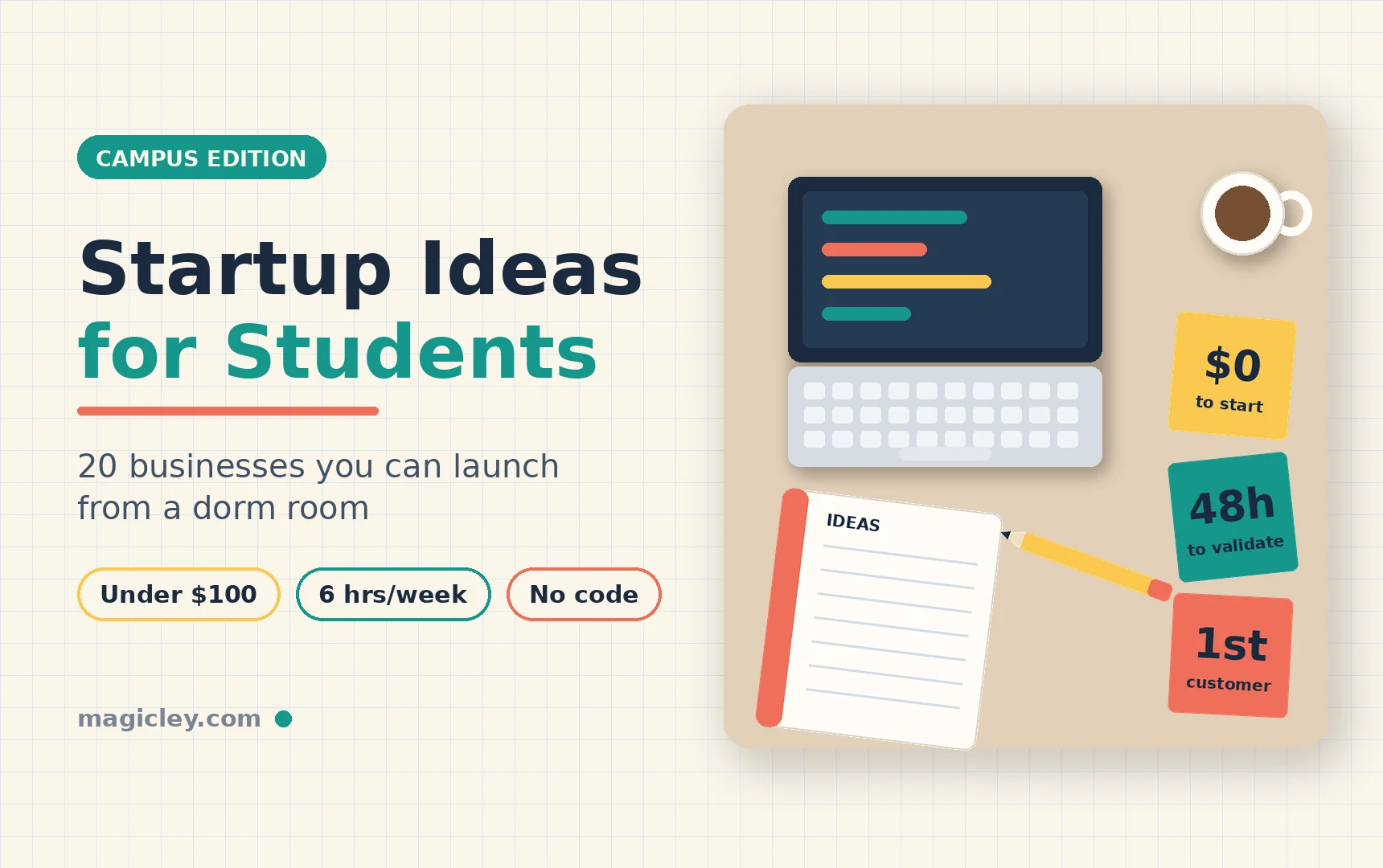
20 Startup Ideas You Can Actually Run From a Dorm
Sorted by what they demand from you. Most need under $100 to start.
Campus Services (Your Market Is Downstairs)
1. Move-out logistics service — Every May, thousands of students panic about storage and shipping. Rent a truck for a weekend, charge per box, sell out annually. The demand is a calendar event.
2. Dorm-room setup and assembly — Freshman parents pay handsomely to not build IKEA furniture in August heat. Two people, one drill, one very good weekend.
3. Exam-week care package delivery — Parents want to send something; nobody wants to mail cookies. Build the local fulfillment layer and market to the parents' Facebook group, not students.
4. Campus bike and scooter repair — Fix flats and brakes between classes at a fraction of shop prices. Zero marketing needed; park where the broken bikes are.
5. Laundry service for the chronically busy — Athletes, pre-med students, and anyone in tech-interview season will absolutely pay to skip it.
Skills for Hire (Sell What You're Already Learning)
6. Course-specific tutoring, productized — Not "math tutoring" but "the person who gets you through Organic Chem II." Niche down to one brutal course and own it.
7. Grad school application editing — Personal statements are terrifying and high-stakes. If you write well, this is premium work with a clear season.
8. Small-business bookkeeping for local shops — Accounting majors: local businesses are drowning in receipts and can't afford a firm. Start with two clients.
9. Lab-report and data-visualization help — Science students who can make charts clear are quietly valuable to other science students.
10. Language conversation practice — Bilingual? Conversation partners are a real market, and international students on your own campus are your first customers.
AI-Powered Services (The 2026 Advantage)
You grew up with these tools. Local businesses did not. That gap is a business.
11. Local business AI audits — Walk a restaurant or salon through which AI tools would actually save them hours, then set it up. Charge for the setup, not the advice.
12. Chatbot setup for local services — Dentists, gyms, and tutoring centers all lose after-hours inquiries. You can build them one in an afternoon with a no-code chatbot builder and charge a setup fee plus monthly maintenance.
13. Social content production for small brands — Not "posting" but producing. Batch a month of content in a day using AI content tools, then sell the calendar as a package.
14. Product listing optimization for Etsy and Amazon sellers — Descriptions, titles, keywords. Sellers know their listings are weak and rarely have time to fix them.
15. Podcast and lecture clipping service — Turn long recordings into short clips for creators, coaches, and professors building an audience.
Digital Products (Build Once, Sell Repeatedly)
16. Course-specific study guide packs — The notes you already take, cleaned up and sold to next semester's students. Ask about your school's academic-integrity policy first, then sell to your own campus and the ten most similar ones.
17. Notion templates for student life — Thesis trackers, internship application pipelines, lab-notebook systems. You know exactly what's missing because you needed it last week.
18. Niche newsletter with a job board — Pick a field you're entering, curate weekly, add entry-level roles. Two years of this makes you employable and possibly self-employed.
19. Print-on-demand for campus micro-cultures — Not generic school merch (licensing issues) — inside jokes for the marching band, the engineering studio, the ultimate frisbee league.
20. Roommate/housing matching for your city's student market — A curated group plus a light vetting process beats the chaos of Facebook housing groups, and landlords will pay for reliable referrals.
Pick One in a Week (Without Skipping Class)
The failure mode here is browsing this list for three months. Here's the compressed version of the idea validation workflow, sized for a student schedule:
Monday — Pick three. Score each on: Can I start this with under $100? Can I deliver it in under 6 hours a week? Do I personally know ten potential customers? Anything scoring poorly on two of three is out.
Wednesday — Talk to five humans. Not "would you use this?" (everyone says yes to be nice). Ask "how do you handle this problem now, and what did it cost you last time?" You're listening for annoyance, not politeness.
Friday — Sell before you build. Offer it to one person at a real price. Not free, not "beta." If nobody pays, you learned in four days what most founders learn in four months.
Sunday — Ship the ugly version. A Google Form, a phone number, and a spreadsheet is a legitimate business. Infrastructure comes after customers, never before.
If you want to generate more options tailored to your own skills and campus, feed those constraints into an AI business idea generator — the specific inputs are what turn generic output into something worth testing.
The Honest Constraints
Three things I'd tell my younger self:
-Don't drop out for a dorm business. Almost none of these are the next unicorn, and that's fine — they're for skills, money, and evidence you can execute. The degree is cheap insurance you're already paying for.
-Service businesses beat product businesses at your stage. Services pay this month; products pay maybe. Start with cash flow, use it to fund the ambitious thing later.
-Your first business is a class you get paid for. Whatever it earns, it teaches sales, delivery, and pricing — the exact things that make the second one work. Judge it on what you learn, not what it grosses.
FAQ: Startup Ideas for Students
How much money do I need to start? Most ideas here start under $100 — several under $20. The scarce resource for students isn't capital, it's focused hours, so pick by time cost, not startup cost.
Can I run a business while taking a full course load? Yes, if it's service-based and schedulable. Avoid anything demanding instant response (live support, same-day delivery) during exam season, and set client expectations about your availability up front.
What if my idea already exists? Good, it means there's a market. On a single campus, being the person who shows up reliably beats being first. Execution and proximity are your edge, not novelty. (The research on AI creativity makes the same point: ideas are abundant, follow-through isn't.)
Should I use AI to run my student business? For the parts that aren't the product, absolutely, marketing copy, naming, scheduling, admin. That's how one person delivers what used to take three.
Bottom Line
You don't need a garage, a co-founder, or a pitch deck. You need one idea small enough to start this week, five honest conversations, and a first customer who pays real money. The advantages you have right now are the free test market, the low stakesand the goodwill.
Pick one from the list, or generate ideas around your own skills and campus free. Then go ask five people about it before Friday.