I'll admit something embarrassing: I used to keep a notebook of "million-dollar business ideas." Most entries were three words long, written at 2am, and made zero sense by morning. What that notebook never had was the part that actually matters, is there a market, who's the customer, and how would it make money?
That's the gap an AI business idea generator closes. Not the shower-thought part, but the unglamorous first-pass analysis that turns "an app for X" into something you can actually evaluate. I use one weekly now, both for my own projects and when readers ask me "what should I build?" Here's exactly how it works, with a real example straight from the tool.
What an AI Business Idea Generator Actually Does
A good one doesn't just spit out random combinations of trendy words ("Uber for plants! Netflix for socks!"). It generates a structured mini-brief: the idea, the market opportunity behind it, the target audience, and a plausible business model. In other words, it does the first 30 minutes of homework you'd otherwise skip.
Here's a real, unedited output from Magicley's Startup Ideas generator , I typed in health and wellness keywords and this came back in about ten seconds:
Look at what's actually in that result:
-The idea itself: an AI-driven personal health monitoring and advisory platform — specific enough to evaluate, broad enough to shape.
-Market opportunity: it identifies the shift toward personalized, preventative healthcare and the consumer demand driving it. (And it's onto something , health AI is one of the fastest-growing categories in the industry right now.)
-Target audience: not "everyone" — it names primary users (health-conscious individuals, chronic disease patients) and secondary ones (fitness professionals, nutritionists, providers) who'd use the platform differently.
-Business model: tiered subscriptions, from basic tracking to advanced analytics and coaching , a real revenue structure, not "we'll figure it out."
-Key features: AI health analytics from wearable data, personalized advisory plans, a virtual health coach.
Is this a finished business plan? Absolutely not. Is it a better starting point than my 2am notebook? Painfully, yes.
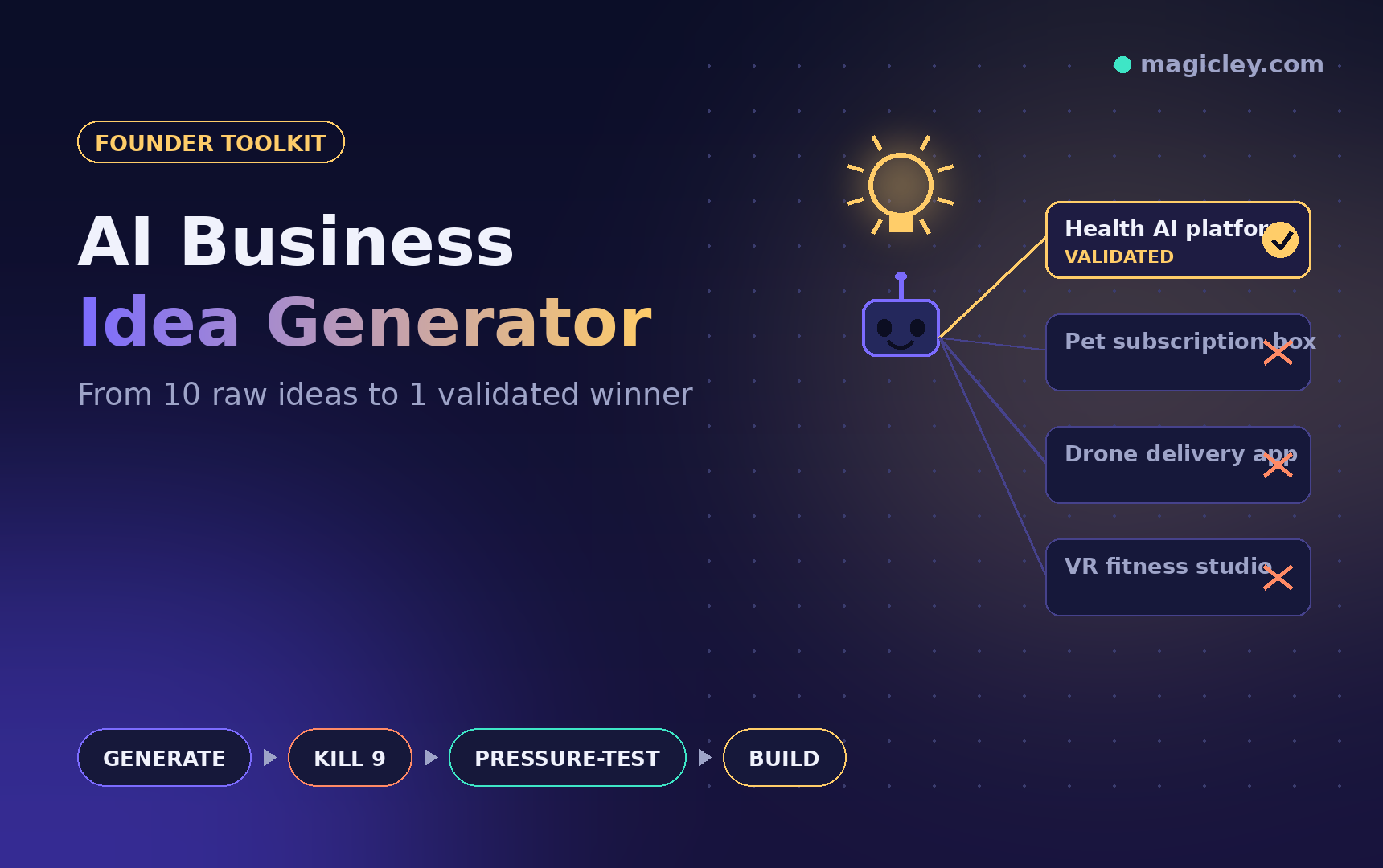
My 4-Step Workflow: From Generated Idea to Validated Direction
The generator is step one, not the whole journey. Here's the process I actually follow:
Step 1: Generate in batches of 10
Feed the tool your constraints — industry keywords, skills, budget hints — and generate at least ten ideas. The first one is rarely the winner; the magic is in comparing. This is the same principle behind every AI content workflow that outperforms: AI for volume, human judgment for selection.
Step 2: Kill nine of them fast
For each idea, ask three brutal questions: Would I pay for this? Can I reach these customers without a fortune? Can I build a first version with what I have? Anything that fails two of three dies. No mercy, the generator can make more.
Step 3: Pressure-test the survivor
Take your survivor back to the AI and interrogate it: "What are the three biggest risks of this idea?" "Who are the existing competitors?" "What would a skeptical investor say?" The same engine that generated the idea is surprisingly good at attacking it and far cheaper than learning those objections from the market.
Step 4: Name it and test the pitch
Once an idea survives, give it an identity , a product name that works across markets and draft a one-paragraph pitch. If you can't make the pitch exciting with AI's help and your own conviction, that's data too.
Total time: about an hour. My notebook era averaged four months per idea to reach the same clarity, mostly spent avoiding the question.
Who Gets the Most Out of These Tools
Having watched a lot of people use idea generators, three groups consistently win:
-Aspiring founders stuck in "someday" mode. The blank page is the enemy. A structured idea — even an imperfect one — gives you something to react to, and reacting is easier than inventing. It's the whole reason entrepreneurs get outsized value from AI tools.
-Existing business owners hunting for expansion. Feed it your current niche and audience, and it becomes an adjacency finder: new services, new segments, new revenue lines you're already positioned for.
-Content creators and agencies. Idea-stage analysis is a service. Several freelancers I know run client discovery workshops built on generator output, the AI produces the raw directions, they sell the judgment.
The Honest Limitations
Because I'd rather you trust this blog than click one more time: an AI business idea generator can't know your local market's quirks, can't feel whether you'd stay motivated building it, and will occasionally produce ideas that sound plausible but collide with regulation or unit economics it can't see. The health platform above, for instance, would face real compliance work the summary doesn't mention. That's your job — and honestly, the research on AI creativity says the same thing: AI beats humans at generating options, while humans keep the edge at judging what's worth pursuing. Use it accordingly.
FAQ: AI Business Idea Generators
Are AI-generated business ideas original? They're recombinations of patterns , which is also true of most successful businesses. Originality comes from your execution angle, not the idea's novelty. Competition validates a market; execution wins it.
Can I use a free AI business idea generator? Yes , Magicley's Startup Ideas tool is included in the free plan, along with 200+ other tools, no credit card required. Generate your ten ideas today and see if one survives Step 2.
How is this different from asking ChatGPT? Purpose-built generators structure the output (market, audience, model) every time, keep your generations organized in one workspace, and sit next to the tools you'll need for steps 2–4 — naming, pitch drafts, landing page copy , so validation happens in one place instead of ten tabs.
The Bottom Line
Ideas were never the bottleneck , structured evaluation was. An AI business idea generator gives every idea the same fair, fast first-pass analysis, so your judgment gets spent where it matters: picking, testing, and building.
My 2am notebook is retired. Generate your first ten startup ideas free and let one of them survive the morning.